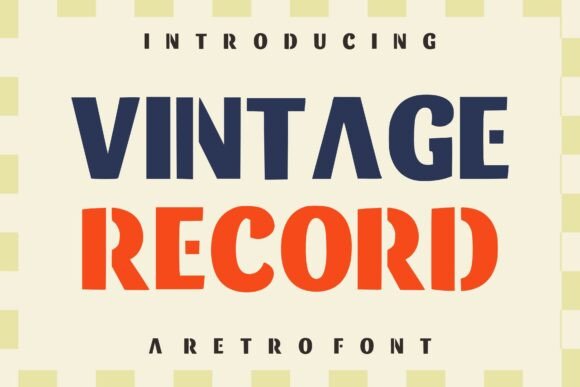
Vintage Record: A Retro Display Font for Handmade Brands
If you’ve ever held a warm-toned vinyl record sleeve and felt that instant spark of nostalgia—clean lines, bold lettering, mid-century charm—you’ll love Vintage Record. This isn’t just another retro font. It’s a carefully crafted display typeface built for makers who sell real things: hand-poured candles in apothecary jars, wedding welcome boards hung on barn doors, boutique gift tags tied with twine, or printable wall art sold as digital downloads. Its strong geometric shapes and confident rhythm give your products presence—without sacrificing legibility or craft-friendly practicality.
Why Vintage Record Works So Well on Physical Products
Vintage Record shines where many retro fonts stumble: readability at small sizes and clean cut lines for cutting machines. Its uppercase-heavy structure, generous x-height, and open counters mean it holds up beautifully on 1-inch sticker labels, 2-inch product tags, or heat-pressed tote bags—even when scaled down for Cricut or Silhouette use. Unlike overly ornate scripts or condensed sans serifs, Vintage Record balances personality with precision. That makes it ideal for packaging design where customers need to instantly recognize your brand name, flavor, or collection title.
I’ve used it for candle labels (think “Honey & Sage” stamped on kraft paper), farmhouse-style wooden signs (“Gather Here”), and holiday gift tags (“Hand-Poured • Made With Love”). Each time, customers comment on how “vintage but fresh” the text feels—like it belongs both in a Brooklyn coffee shop and a Tennessee cottage kitchen.
Where to Use Vintage Record in Your Shop
- Labels & Tags: Perfect for jar labels, soap wraps, and boutique hang tags—especially when paired with a subtle serif or neutral sans serif for ingredients or care instructions.
- Invitations & Stationery: Wedding welcome signs, RSVP cards, and menu prints gain instant warmth and intentionality. Try it for names and headings, then switch to a soft script font for body text or accents.
- Digital Printables: Planner covers, quote posters, and printable calendars all benefit from its bold, centered impact—especially when printed at home or through print-on-demand services.
- Mugs, Totes & Apparel: Because Vintage Record avoids thin strokes and tight spacing, it transfers cleanly onto ceramics and fabric. No broken letters, no fuzzy edges—even at 36pt on a ceramic mug.
- Social Media Graphics & Mockups: Its strong silhouette renders crisply in thumbnails and Instagram carousels, helping your product photos stand out in crowded feeds.
Pairing Vintage Record Thoughtfully
Display fonts like Vintage Record aren’t meant to carry long paragraphs—but they’re powerful anchors for smart font pairing. For physical products, I default to two reliable combos:
- A bold display + a clean sans serif: Pair Vintage Record with something like Montserrat or Inter for ingredient lists, size charts, or website banners. The contrast feels modern yet grounded—ideal for small-batch skincare or pantry goods.
- A bold display + a gentle script: Use Vintage Record for headlines (“Our Story”) and a relaxed handwritten font (like Quicksand or Pacifico) for subheads or quotes. This works beautifully for wedding stationery, greeting cards, and boutique packaging.
Avoid pairing it with other heavy display fonts or overly decorative serifs—they compete instead of complement. And skip using it for full-body text: it’s a display font, not a workhorse text face. Save it for what it does best: commanding attention in under ten words.
What’s Inside the Vintage Record Font Files?
The Vintage Record package includes OTF and TTF formats—both fully compatible with Cricut Design Space, Silhouette Studio, Canva, Adobe Illustrator, and Procreate. There are no hidden surprises: no missing glyphs, no limited language support. It covers Western European languages and includes standard ligatures and stylistic alternates (like a swash “A” or alternate “R”)—small touches that add polish to premium printables or SVG bundles.
Importantly, it comes with a clear commercial license. That means you can use Vintage Record to create and sell physical products (candles, mugs, shirts), digital downloads (planner pages, quote art, Canva templates), client work (logo lockups, shop signage), and even SVG files for crafters’ cutting machines—no extra fees or attribution required. Just keep your license file handy for platform audits or wholesale partners who ask.
Realistic Tips for Best Results
When designing for cut files: convert Vintage Record to outlines before exporting SVGs—this prevents font substitution errors on buyers’ machines. For small stickers or tags under 1 inch, stick to all-caps phrases and avoid tiny punctuation (like periods or commas). On dark backgrounds, add a subtle white stroke or shadow—it boosts contrast without losing that authentic retro feel.
For printed cards or packaging: test print at 100% scale first. Its bold weight reads well on textured papers, but avoid ultra-thin stocks where ink might bleed. And if you're building a cohesive brand identity, use Vintage Record consistently for your shop name, collection headers, and hero product titles—customers begin to associate that clean, confident geometry with your handmade quality.
This is more than a font—it’s a quiet signature. One that says you value both craftsmanship and clarity. Whether you’re launching your first Etsy shop or refining a decade-old label line, Vintage Record gives your products visual weight, emotional resonance, and real-world usability. Not every display font earns its place on a shelf, a mug, or a wedding arch. Vintage Record does.